
Compliance & Audit Standard 2026
Certificate of Data Destruction:
What It Must Include (Free Template Inside)
A certificate of data destruction is a record that proves the data on a specific device was destroyed. It names the device, the method used, the result, the date and the person responsible. Auditors, customers and insurers ask for it because "we wiped it" is only a claim, and a record is evidence.
By Prashant Saini, Compliance & Security Lead at D-Secure•Last updated: October 9, 2026•8 min read
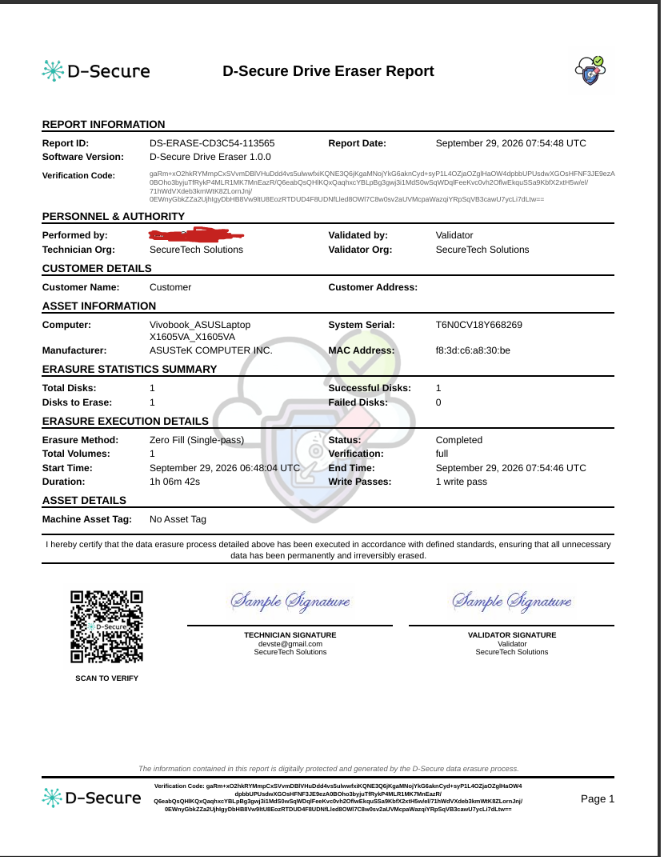
Table of Contents
- 1. Does D-Secure Provide a Certificate?
- 2. Destruction vs. Erasure Certificate
- 3. What Must a Certificate Include?
- 4. Free Data Destruction Template
- 5. When Do You Need Proof of Erasure?
- 6. The Erasure Report Audit Trail
- 7. 5 Mistakes That Ruin Records
- 8. Who Needs Automatic Reports?
- 9. Frequently Asked Questions
Does D-Secure Provide a Certificate of Data Destruction?
D-Secure does not issue a separate handwritten certificate file. After every erasure, Drive Eraser generates a comprehensive report, and the first page of that report serves as the complete, tamper-evident audit trail.
The audit trail records what was erased, the method used and the result of the wipe. Teams attach that page to the asset record, send it to an auditor or give it to a customer as their formal proof of erasure.
If your auditor or customer asks for a particular certificate format, compare their requirements with the report before you buy. You can also tell us what they ask for and we will say whether the report covers it. In the general sense, a certificate of data destruction is any record that proves the data on a specific device was erased: which device, which method, what result and when.
What Is the Difference Between a Certificate of Data Destruction and a Certificate of Erasure?
A certificate of erasure proves software wiped the data and the device can be reused. A certificate of destruction proves the media was physically destroyed. The two terms are often used as if they mean the same thing, but they describe different outcomes.
| Aspect | Certificate of Erasure | Certificate of Destruction |
|---|---|---|
| What happened | Data was wiped with software and the device can be reused | Media was physically destroyed (shredded, crushed, degaussed) |
| Device afterwards | Reusable, resalable | Not reusable (e-waste) |
| Proof comes from | Software verification and the erasure report | A destruction vendor's manual record |
| Best for | Laptops, servers and drives you plan to resell or redeploy | End-of-life media with no resale value or damaged drives |
💡 IT Asset Management Insight: Most IT teams retiring working laptops and servers need proof of erasure, not destruction. Wiping the drive with software and keeping a digital record allows you to recover residual hardware value, support ESG circularity goals, and eliminate e-waste.
What Must a Certificate of Data Destruction Include?
A certificate of data destruction must name the device, the erasure method, the result and the date. An auditor will usually accept a record with those four things plus the operator identity. Check yours for these ten critical data points:
01
Unique Report / Record ID
A tamper-evident identifier to trace the record in central databases.
02
Device Details
Hardware make, model, chassis serial number, and internal asset tag.
03
Drive Details
Media type (HDD, SSD, NVMe), total capacity, and manufacturer disk serial number.
04
Erasure Standard & Method
Exact sanitization algorithm applied, e.g., NIST SP 800-88 Clear or Purge.
05
Software Name & Version
The certified software build used to execute the sanitization process.
06
Start & End Timestamps
Accurate ISO-formatted date and time markings for the wipe duration.
07
Verification Outcome
Read verification proof confirming 100% or sampled sector sanitization (0x00).
08
Operator Details & Site
Technician username/ID and the physical facility or remote location.
09
Customer / Asset Reference
Organization name, department reference, or client ownership link.
10
Tamper-Evident Seal
Cryptographic hash or digital signature to immediately detect post-erasure edits.
Audit Warning: If a record has no serial number and no named sanitization method, it is merely a receipt, not legal proof.
Free Certificate of Data Destruction Template
Copy this standard table format into your internal documentation system if you issue manual records for small batches:
| Required Field | Field Description / Sample Entry |
|---|---|
| Record ID | e.g., REC-2026-NIST-8842 |
| Date of Erasure | e.g., 2026-10-09 14:30 UTC |
| Organisation / Asset Owner | e.g., Acme Corporation / Finance Dept |
| Device Make and Model | e.g., Lenovo ThinkPad X1 Carbon Gen 10 |
| Device Serial Number | e.g., PF2X89LM |
| Asset Tag | e.g., IT-ASSET-09412 |
| Drive Type and Capacity | e.g., M.2 NVMe SSD 1TB |
| Drive Serial Number | e.g., S649NF0T112904W |
| Erasure Standard and Method | e.g., NIST SP 800-88 Purge (Cryptographic Erase + Overwrite) |
| Software and Version | e.g., D-Secure Drive Eraser v4.2 |
| Verification Result | e.g., Pass (100% Sectors Verified Clean) |
| Operator Name | e.g., Jane Doe (ITAD Technician) |
| Location / Facility | e.g., London Data Centre Bay 4 |
| Signature & Date | [Digital Signature Hash or Signoff] |
The Scaling Challenge: Hand-written or manual records stop working at volume. At 50 devices a month, filling these fields takes hours, and a single typo in a disk serial number weakens the entire legal defensibility. That is why enterprise teams migrate to automated tools like D-Secure Drive Eraser that read drive metadata and write the record automatically.
When Do You Need Proof of Data Erasure?
Proof requirements depend on your industry, geographic territory, and contractual agreements. Modern compliance mandates strict verification:
GDPR & DPDP Act 2023
EU GDPR Article 17 requires organizations to prove lawful erasure. India's Digital Personal Data Protection (DPDP) Act 2023 requires personal data to be permanently erased once its specified purpose is served.
HIPAA & PCI DSS 4.0
HIPAA Security Rule requires documented sanitization of ePHI before hardware disposal. PCI DSS 4.0 Requirement 9.8 mandates strict audit trails for retired media handling cardholder data.
NIST SP 800-88 Rev. 2
The NIST SP 800-88 Rev. 2 standard treats comprehensive documentation and verification as integral components of any media sanitization program. Learn more in our NIST Clear vs Purge guide.
Cyber Insurance & ITAD
Underwriters and corporate customers routinely mandate certified proof of erasure prior to lease return, resale, or cloud asset decommission to mitigate third-party supply chain liabilities.
* Note: The information provided above constitutes general operational guidelines and does not substitute for formal legal counsel. Always consult your compliance and legal department for jurisdiction-specific regulations.
The Erasure Report: Your Audit Trail for Every Wipe
D-Secure Drive Eraser generates an erasure report after each wipe. The first page is the audit trail. It records what was erased, with which method, and what the result was. You can attach it to the asset record, send it to an auditor or hand it to a customer.
Automated, Tamper-Evident Report Generation
Because D-Secure software interrogates disk controllers directly via low-level firmware protocols, hardware serial numbers and drive geometries are captured automatically—eliminating manual clerical errors.
Per-Device Trail
Each individual drive receives a dedicated record ID and report.
Deep Verification
Automated hex verification passes ensure no readable remnants remain. See our verification guide.
Export Flexibility
Reports export seamlessly as signed PDF or structured XML/JSON for ITAM APIs.
Five Mistakes That Make Erasure Records Worthless
When compliance auditors inspect IT disposition logs, they routinely reject certificates that commit these five fundamental errors:
1. Missing Drive Serial Numbers
Recording '1x Laptop wiped' without linking the exact chassis and disk serial number invalidates chain of custody.
2. No Sanitization Standard Specified
Failing to state whether NIST SP 800-88 Clear, Purge, or DoD 5220.22-M was executed.
3. Editable Plain-Text Formats
Saving logs as unsealed Word or plain text files without cryptographic checksums or tamper-evident signatures.
4. Storing Records on Retired Assets
Failing to store audit certificates in centralized cloud repositories before the decommissioning host machine is shut down.
5. Logging Success Without Sector Verification
Marking a drive as clean when bad sectors, hidden HPA blocks, or write errors were never verified.
Who Needs Automatic Erasure Reports?
ITAD Providers & Recyclers
Must deliver verifiable proof to clients for every batch of processed endpoints and enterprise storage arrays.
Enterprise IT Teams
Retiring employee laptops, desktop PCs, and servers on regular lifecycle refresh schedules needing repeatable trails.
Hardware Refurbishers
Building buyer confidence by providing cryptographic proof that previous user data was permanently purged.
Regulated Enterprises
Financial institutions, healthcare networks, and government suppliers obligated to present audit-ready records instantly.
Frequently Asked Questions
What is a certificate of data destruction?
It is a formal record confirming that data on a specific device was destroyed. It records the sanitization method, date, operator, verification outcome, and exact device serial identifiers.
Is a certificate of erasure the same as a certificate of destruction?
Not exactly. A certificate of erasure covers software-based wiping where the underlying storage hardware remains intact and reusable. A certificate of destruction typically covers physical shredding or degaussing. Many organizations use the terms interchangeably in audit contexts.
Is proof of data destruction legally required?
Yes, under frameworks like GDPR Article 17, India's DPDP Act 2023, HIPAA Security Rule, and PCI DSS 4.0. Regulators mandate that organizations demonstrate accountable proof of sanitization for retired media.
Can I create my own record using the template above?
Yes, for small internal batches using our free template. However, at enterprise volume, manually entering hardware serial numbers creates high clerical risk; software-generated reports provide far greater legal defensibility.
Does D-Secure provide a certificate?
D-Secure Drive Eraser automatically generates an erasure report after every wipe. The first page of that report is the audit trail, and teams use it directly as their proof of erasure for auditors and clients.
How long should I keep erasure records?
Retention periods depend on corporate data retention policies and statutory requirements. Most enterprise compliance frameworks recommend retaining sanitized asset audit trails for 3 to 7 years.
See the Erasure Report for Yourself
Want to inspect what the D-Secure audit trail looks like, or check Drive Eraser against your record-keeping requirements? Connect with our compliance specialists.
Solutions for Your Enterprise
Explore the full D-Secure data security suite
Drive EraserNIST 800-88 compliant HDD & SSD secure erasure
Smartphone Erasercompliant iOS & Android mobile data wipe
File EraserSecure file & folder shredding beyond Recycle Bin
Expert Solution
How Do Experts Handle This?
Enterprise-grade data sanitization requires more than just standard deletion. Experts use professional software like Drive Eraser to ensure 100% data destruction across all media types.
Standard Compliance
Meeting NIST 800-88 and GDPR standards with full audit trails.
Enterprise Ready
Scalable solutions for ITAD partners and large organizations.
Securing Data Everywhere
Trusted by global enterprises for zero-leakage data sanitization.
100%
Verified
0
Leaks
24/7
Support
Comments (0)
Your email address will not be published. Providing an email is optional.
Have Questions About This Topic?
Send us an enquiry regarding: Certificate of Data Destruction: What to Include + Template
No comments yet. Be the first to comment.